
SR1010 LE-UWBTM Wireless Transceiver IC
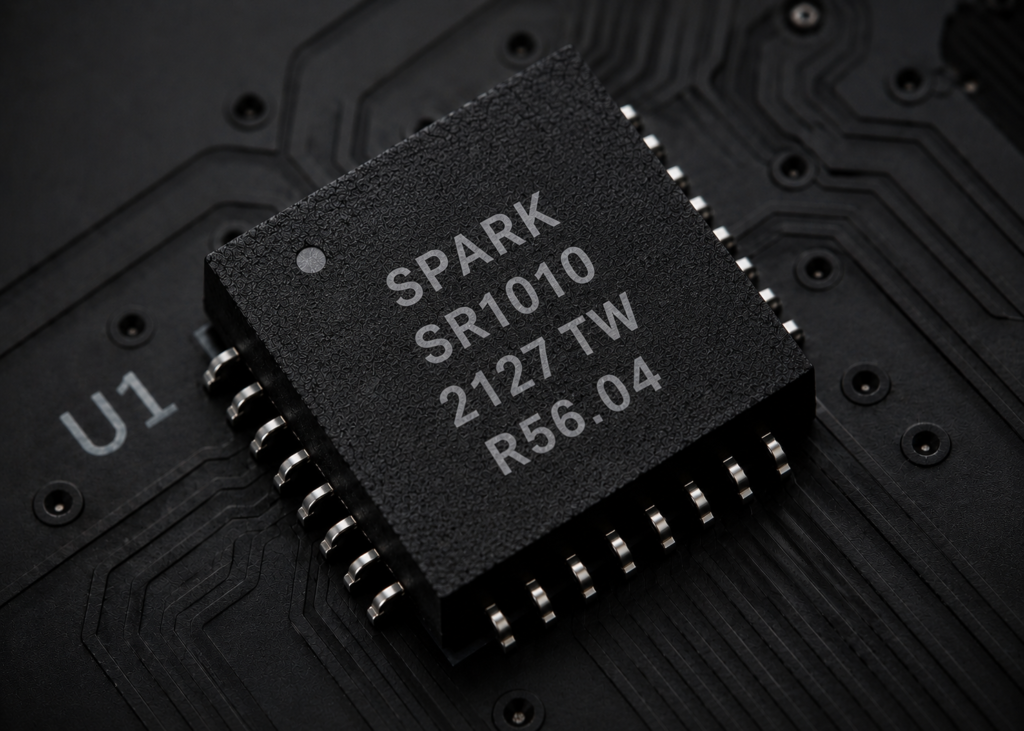
The SR1010 is SPARK's LE-UWB™ transceiver for the sub-6 GHz band. Operating from 3.1 to 5.8 GHz, it is the only SPARK transceiver covering this frequency range, enabling deployments across a broad range of applications and in regions with sub-6 GHz UWB regulatory constraints. It delivers ultra-low power consumption and 50 µs airtime latency in a compact 4 mm × 4 mm QFN28 package.
Overview
Engineered for the wire-free edge
Ultra-low power
The SR1010's aggressively duty-cycled architecture enables multi-year operation on a coin cell battery and supports battery-less energy harvesting applications. Active receive draws 0.34 mA/Mbps; active transmit draws 0.10 mA/Mbps. Deep sleep current is 920 nA; shutdown is 55 nA.
Very-low latency
50 µs airtime for 1 kbit.
Deterministic; the same on every transmission. Enables real-time wireless data streams for IoT and sensor applications where timing consistency is critical.
Deterministic; the same on every transmission. Enables real-time wireless data streams for IoT and sensor applications where timing consistency is critical.
Robust coexistence
Carrier-Sense (CSMA) stack support and dynamically reconfigurable spectrum enable operation alongside BLE, Wi-Fi (2.4, 5, and 6 GHz), and cellular. Dynamic spectrum shaping ensures compliance with international UWB emission limits across multiple regulatory domains.
Low-cost integration
Single 32.768 kHz external crystal. High-efficiency PCB antenna, no external antenna component required. Standard SPI interface for straightforward MCU integration. 4×4 mm QFN28 footprint with a small number of external components required.
Specifications
Complete electrical parameters
RF Performance
Frequency band
3.1–5.8 GHz
TX power
Up to 3 dBm/20 MHz
RX sensitivity
−75 dBm/20 MHz
Symbol rates
20.48 MHz
Link budget
75 dB (at 0 dBm/20 MHz TX)
TX bandwidth
500 MHz–3 GHz reconfigurable
Digital & Interface
TX FIFO
1 kbit independent
RX FIFO
1 kbit independent
NVM
1 kbit
Host interface
Standard SPI (up to 40 MHz)
Modulation
OOK, differential encoding
FEC
Punctured convolutional, 1/1.33 / 1/1.66 / 1/2.0 rate
CRC
16-bit programmable
Sync word
32-bit programmable
Protocol support
Carrier-Sense (CSMA) stack, Auto Reply
Power
Supply voltage
1.8–3.3 V
Active RX
0.34 mA/Mbps
Active TX
0.10 mA/Mbps
Idle
280 µA
Shallow sleep
41 µA
Deep sleep
920 nA
Shutdown
55 nA
Internal DC-DC
1.0 V regulated, 79% efficiency at 20 mW load
Physical
Package
QFN28, 4×4 mm
Also available
WLCSP
Operating temperature
−40 to +85°C (industrial)
Antenna interface
100 Ω differential, no matching components required
External crystal
32.768 kHz (single, required)
Antenna diversity
Not supported (see SR1120 for antenna diversity)
Ordering
Ordering information
WLCSP package also available. Contact sales for availability and pricing. Volume pricing available on request.
Reference Designs & Demos
Launch-ready silicon foundations
The SR1120 is the silicon foundation for SPARK's complete library of reference designs.