
SR1120 Evaluation Kit
6.2–9.5 GHz · Up to 40.96 MHz symbol rate · Ultra-low latency · Full SDK access.
Built around SPARK’s SR1120 transceiver, the EVK lets engineering teams benchmark performance, prototype applications, and validate design assumptions before silicon integration.
Hardware
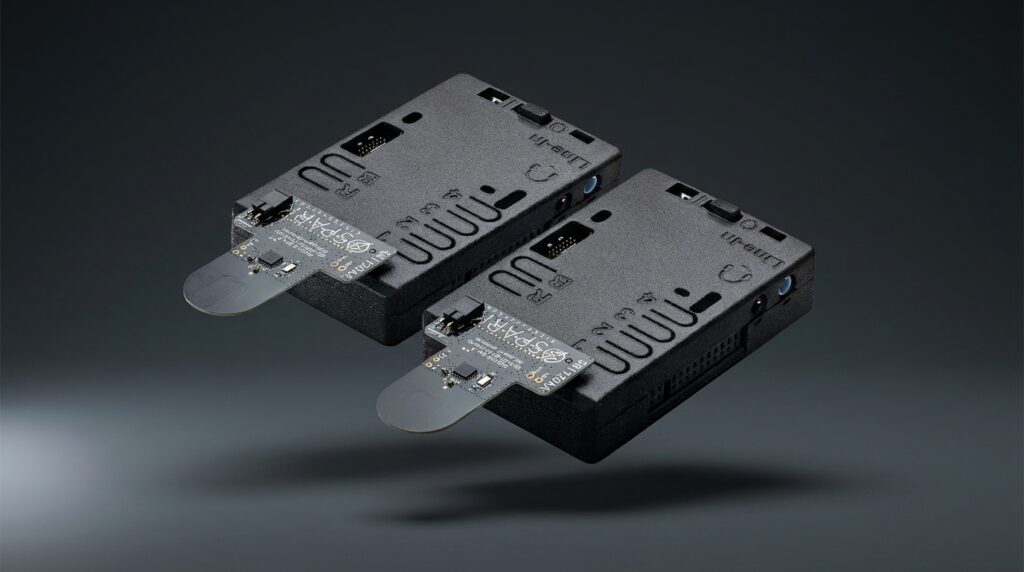
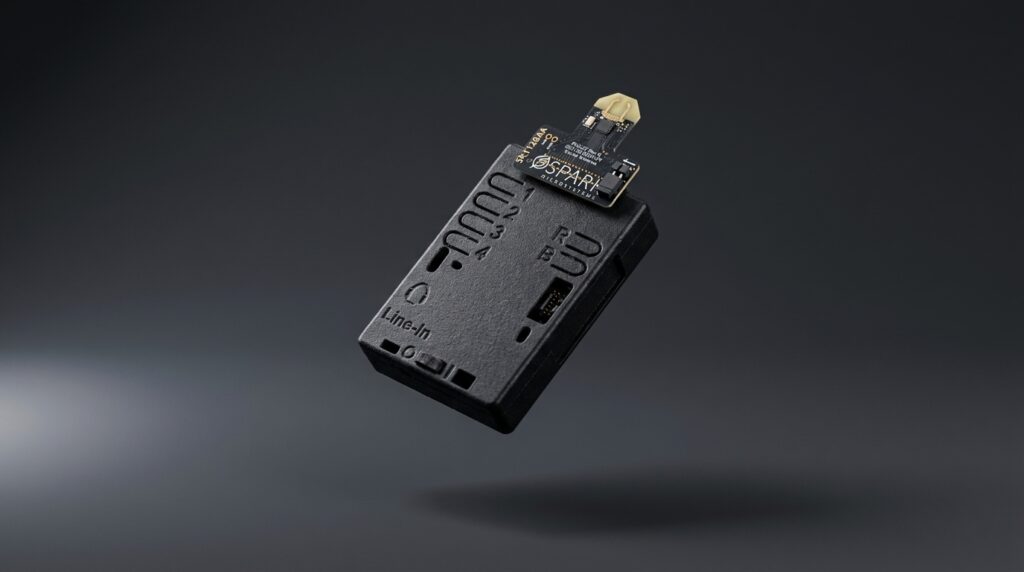
Evaluation kit features
- SR1120 LE-UWB™ transceiver – 6.2–9.5 GHz, up to 40.96 MHz symbol rate
- STM32U5 MCU (Arm Cortex-M33, up to 160 MHz, 4 MB flash, 2.5 MB RAM)
- Analog Devices MAX98091 audio codec – stereo line-in, microphone input, headphone output, 8–96 kHz, PCM/I2S
- Dual-antenna and dual-radio support
- PCB trace antenna. No external antenna required
- Onboard buttons, status LEDs, RGB indicators, and test points for interactive prototyping
- USB-C – power, charging, and data over a single cable
- Li-Ion battery with selectable 1.8V/3.3V supply via firmware
- Dual QSPI and multiple SPI interfaces
Software
The SPARK EVK
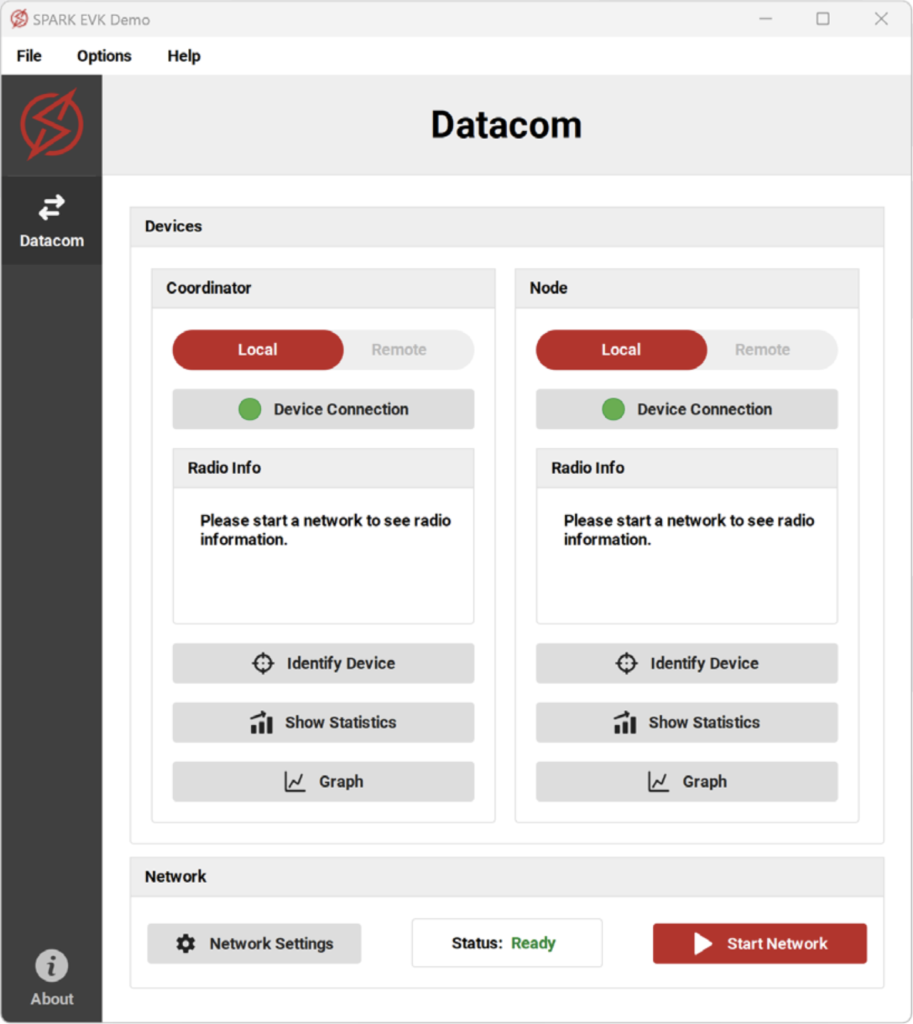
The EVK comes with a comprehensive software suite for evaluating the SR1120 UWB transceiver. It streamlines and accelerates evaluation and development of applications such as low-latency and low-power data exchange between two transceivers.
Features
Datacom application features
Experience unparalleled control and insight with our comprehensive configuration and monitoring features. Our advanced system offers intuitive tools and real-time diagnostics to streamline your setup and troubleshooting process. Explore the following key functionalities:
Comprehensive configuration
Intuitive tools for customizing devices, networks, data rates, and frequency settings.
Real-Time Monitoring and Diagnostics
Immediate visual feedback on system status through RGB LED indicators, aiding quick troubleshooting.
Advanced Device Management
Remote configuration capabilities for managing all setup aspects, even for long-range tests, via the 'Devices' and 'Network' sections.
Insightful Statistics and Analysis
Detailed insights into network performance, including data transfer rates, signal metrics, and visual metrics such as signal strength and packet delivery ratio.
Customizable Data Transfer Settings
Flexible communication settings for optimized speed and reliability, supporting both unidirectional and bidirectional transfers.
Specifications
Complete parameters
Processor
MCU
STM32U5 (STM32U5A5AJH6Q)
Architecture
32-bit Arm Cortex-M33
Speed
Up to 160 MHz
Memory
4 MB flash, 2.5 MB RAM
Radio
Transceiver
SR1120
Frequency Band
6.2–9.5 GHz
Symbol Rates
20.48 / 27.31 / 40.96 MHz
Antenna
PCB trace, dual-antenna support
Audio
Codec
Analog Devices MAX98091
Audio I/O
Stereo line-in, microphone input, headphone output
Sample Rates
8 kHz – 96 kHz
Formats
PCM, I2S
Audio Additional
Headphone amplifier, 7-band parametric EQ
Connectivity & Power
Interfaces
USB 2.0 High-Speed, dual QSPI, multiple SPI
Supply Voltage
1.8V / 3.3V selectable via firmware
Power Source
Li-Ion battery + USB-C
What you can evaluate
High-speed data links
Impulse radio requires no carrier wave and no complex timing lock. Data transmission begins immediately. End-to-end latency is deterministic and constant, every time; with no jitter introduced by congestion, retries, or protocol overhead.
Uncompressed wireless audio
Test full-fidelity audio streaming via the integrated MAX98091 codec. Stereo line-in, headphone output, and microphone input of up to 96 kHz / 24-bit. Evaluate the same audio path used in the headset reference design.
IoT, robotics, and wearables
Prototype low-latency data links for real-time control systems, sensor nodes, and wearable devices. Application examples in the SDK cover common LE-UWB™ workloads across these categories.