Competitive gaming is a latency-driven world. Every microsecond between a click and the action appearing onscreen can be the difference between a victory and a missed opportunity. 2025 has already been a big year for wireless mice, with major brands pushing polling rates and sensors to new heights. At SPARK Microsystems we applaud the innovation. But we also know that raw numbers on a specification sheet don’t always tell the full story, especially when congestion and limited 2.4 GHz radios start to bite.
The State of Wireless Gaming Mice Today
Mainstream gaming mice still use a 2.4 GHz radio link, it has been this way for 25 years. Nonetheless, flagship devices take major steps to reduce click latency. PC Gamer’s 2025 roundup even crowned the best 2.4 GHz wireless gaming mouse thanks to its smooth sensor and a dongle that supports an 8 kHz polling rate, though the feature is expensive and saps battery life. Independent measurements around the web put its average latency at roughly 0.29 ms, a good improvement over earlier 2.4 GHz mice, but the variance is broad: the histogram of click times can go up to more than 430 µs. Gamers would expect more consistency.
Innovation needs to plow ahead, and the wireless radio is a key piece of the puzzle to go beyond what is possible today. Bluetooth is not even a contender for serious play and 2.4 GHz radios are maxed out.
Enter SPARK low energy ultra wideband (LE-UWBTM) technology…
LE-UWB™: Already Challenging the Incumbents
Mice based on the LE-UWB™ are soon going to enter the market, but their performance is about to get even better. Current internal testing at 8 kHz shows a minimum latency around 60 µs, an average around 300 µs and a maximum around 406 µs.
Technologies of old like 2.4 GHz are maxing themselves out trying to keep up with wires, and they become highly unstable when exposed to heavy WiFi or USB3 activity (see here if you are curious). Accordingly, since we already solved the power consumption and interference problems, we chose to push LE-UWB™ to see how low our latency could go…
Over a LE-UWB™ link rather than 2.4 GHz, we can avoid congested spectrum, maintaining reliable connections and steady polling rate even when nearby WiFi networks are heavily loaded or common USB 3.x interference is near. SPARK’s own 8 kHz reference design demonstrates this advantage by delivering latencies as low as 0.2 ms and consuming 30 % less power than comparable 2.4 GHz devices. More on this later…
While click-to-screen latency is critical, the responsiveness of a gaming mouse also depends on how quickly the optical sensor can detect motion and relay it to the host. We recently measured sensor latency, from the optical sensor’s motion interrupt pin to the USB dongle, for the top 2.4 GHz gaming mouse and our LE-UWB™ reference mouse design, both running at an 8 kHz polling rate.
The results speak for themselves with regards to sensor wireless latency:
- 2.4 GHz: 356–618 µs (avg. 497 µs)
- LE-UWB™: 229–501 µs (avg. 363 µs)
That’s a sensor wireless latency advantage of ~130 µs for LE-UWB™. Our LE-UWB™-based mouse reference design transfers motion data to the PC faster than one of the most recent and highly regarded 2.4 GHz gaming mice on the market. That matters as much as click latency. With our upcoming reference design firmware update discussed next, this gap will widen even further…
Firmware update coming this week! Cutting latency by more than 100 µs.
As 2.4 GHz technology has clearly reached its performance ceiling for gaming, we decided to push further with LE-UWB™ and accelerate past it even further…
The first of two firmware updates is scheduled for release this week for all our customers and shaves off more than 100 µs of latency. This update will reduce latencies across the board. It achieves a minimum click latency of 60 µs, an average of 180 µs and a maximum of 286 µs. In other words, LE-UWB™ will deliver reaction times significantly faster than the average click on today’s top 2.4 GHz gaming mouse.
Because the UWB radio link is resistant to WiFi interference and USB3 noise, the polling rate stays locked at 8 kHz which is as important as raw latency. 2.4 GHz mice often drop packets or fall back to lower polling rates when nearby WiFi or 2.4 GHz traffic fills the band or USB3 noise is near, causing latency to spike into the multi-millisecond range.
Immunity to WiFi Interference: Where LE-UWB™ Stays Rock Solid
Speed is only half the story. Consistence under real-world conditions matters just as much. Our testing shows that today’s top 2.4 GHz gaming mouse can suffer dramatic performance hits in the presence of WiFi interference: polling rates can drop well below 8 kHz and latency can spike by a few milliseconds, a dramatic 10X+ degradation. This is a serious drawback in competitive play, where a single lag spike can decide the outcome.
In contrast, LE-UWB™ technology is inherently immune to such interference. In our measurements, latency and polling rate remained virtually unchanged with or without heavy WiFi activity nearby. This stability means gamers can enjoy wired-like performance without worrying about who else is streaming or gaming in the same space.
Looking Ahead to Later in 2025: An Unbridled Future
Our engineers are not stopping there. A second firmware release planned for later this year will unlock even more latency headroom in the LE-UWB™ mouse platform. Preliminary measurements indicate another 100 µs reduction in latency. Click latencies will be rock-solid at 60 µs for the minimum latency, 115 µs for the average latency, and an unprecedented 175 µs maximum latency. This is more than 2.4 times faster than the best 2.4 GHz radio can offer, while providing better power consumption and more link robustness. This consistency is only possible because LE-UWB™ is inherently built for robust low latency data transport.
Keep in mind that a USB wired gaming mouse running at an 8 kHz polling has very close latency metrics that are within ~30 µs of LE-UWB™ numbers. Combined with our energy-efficient hardware, LE-UWB™ will provide wired-like esports-grade responsiveness without compromising battery life and without having to contend with a wire. That is game changing innovation.
Conclusion: Beyond 2.4 GHz, Why LE-UWB™ Raises the Bar for Wireless Gaming Mice
For years, “top-tier” wireless gaming mice have lived on the crowded 2.4 GHz band. Even with smart frequency-hopping, they still contend with Wi-Fi/Bluetooth traffic and USB 3.x noise near receivers. Reviewers call out the trade-off clearly: push to 8,000 Hz polling and battery life plummets, from ~150 hours to ~22 on one flagship, so most users dial features back to stay powered.
LE-UWB™ is built for performance, without the trade-offs
SPARK’s LE-UWB™ mouse reference design avoids the 2.4 GHz dogfight entirely. It delivers:
- True low-latency clicks: sub-200 µs average click latency in current builds—comparable to the sensor itself and below what narrowband radios can reliably sustain.
- Headroom for high data rates: Ample bandwidth to move rich sensor data without choking under load.
- Real-world resiliency: Operation outside the congested 2.4 GHz band reduces sensitivity to Wi-Fi/Bluetooth collisions and common USB 3.x interference near dongles.
- Power efficiency designed-in: In SPARK testing, our LE-UWB™ mouse reference design shows 30%+ lower system power versus comparable 2.4 GHz designs at like-for-like performance.
Fair comparisons matter
The latest 2.4 GHz mice are impressive, and they deserve the praise. But when you normalize conditions (same polling rate, same DPI, same interference profile), the 2.4 GHz path still forces tough trade-offs in battery life and consistency under congestion. LE-UWB™ gives designers a wider performance envelope: ultra-low click latency, steady sensor throughput, and longer runtimes without sacrificing responsiveness.
What this unlocks for OEMs/ODMs
- Consistent input in busy venues (LAN parties, dense gaming environments).
- Feature headroom for 8K polling, higher DPI pipelines, haptics, and richer telemetry, without the usual “battery tax.”
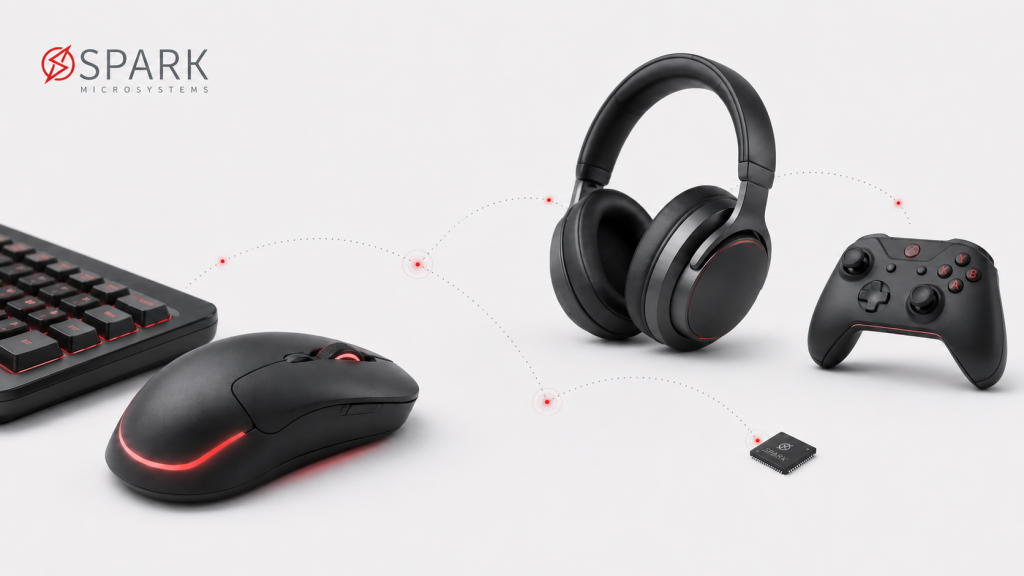
- Future-proof roadmaps that extend beyond mice into keyboards, headsets, and multidevice ecosystems on a single LE-UWB™ stack.
The bottom line
If you’re designing the next generation of gaming peripherals, LE-UWB™ is the right path forward. It removes the hard 2.4 GHz constraints and enables new performance levels and features your users can feel, click after click.
Evaluate it yourself. Get hands-on with SPARK’s 8K LE-UWB™ Mouse Reference Design and talk to our team about integration options.
Note: All internal performance and power data reflect SPARK reference builds and controlled test conditions. Results will vary by implementation.