LE-UWBTM Performance Data
Numbers don't position. They prove.

25μs
BLE 5.2 best-case latency is 7.5 ms is gated by its minimum connection interval. Wi-Fi 6/6E reaches ~7.6 ms under low-load conditions.
LE-UWB is not faster by degree. It operates in a different order of magnitude.
The reason is architectural. Narrowband systems must establish a carrier reference before data can flow that initialization window is non-negotiable and repeats on every transmission burst. LE-UWB’s impulse radio has no carrier to establish. A pulse is sent; the receiver detects it. Transmission begins in nanoseconds.
At 40.96 Mbps, airtime per 1 kbit drops to 50 µs. For systems where a missed timing window means a missed action for a robotic joint, a surgical tool, an XR frame it is a requirement, not a preference.
40.96 Mbps
BLE 5.2 and BLE 6.0 top out at 2 Mbps at the PHY layer. Wi-Fi 6/6E reaches ~150 Mbps, but at +18.5 dBm TX power and 51 mA active current draw, placing it outside the power budget of any battery-constrained short-range device.
LE-UWB reaches 20.48 Mbps at the standard data rate configuration and upto 41 Mbps at maximum mode at 3 dBm/20 MHz TX power. High throughput without the power cost that makes Wi-Fi unsuitable for this class of device.
The throughput advantage follows from channel width. LE-UWB operates at 500 MHz or greater, more than 200× the 2 MHz channel width of BLE. Information capacity scales with bandwidth. Wider channel, more data per second, at the same transmit power.
3 dBm/20 MHz
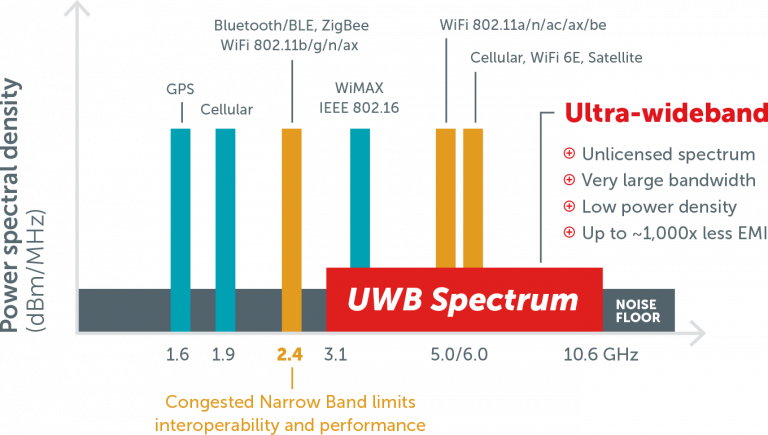
TX power is where coexistence behaviour becomes legible. BLE 5.2 transmits at +8 dBm. Wi-Fi 6/6E at +18.5 dBm. These are the power levels that create congestion in dense RF environments with each device competing for the same spectrum at meaningful signal strength.
LE-UWB transmits at 3 dBm/20 MHz and low enough that BLE and Wi-Fi receivers register it as background noise, high enough to sustain 40.96 Mbps data rates and 200 µs latency simultaneously. It does not compete for spectrum. It coexists.
~2.4 mA TX
Power consumption is where the architectural advantage compounds most visibly against standard UWB.
BLE 5.2 at 0 dBm draws ~4.8 mA TX and ~4.6 mA RX. LE-UWB TX current is comparable to BLE while operating at a fraction of the latency and a multiple of the throughput.
Deep sleep current of 920 nA–1.1 µA makes duty-cycled and energy-harvesting configurations practical. A device that transmits in short high-throughput bursts and sleeps between them can sustain operation on a small battery or harvested energy source; a deployment profile that standard UWB’s 140 mA TX current makes impossible.
−81 dBm
Robustness means two things: the ability to decode a weak signal reliably, and the ability to maintain link integrity in a real-world RF environment with multipath and interference.
On raw receive sensitivity, BLE 5.2 reaches −95 dBm at 1 Mbps, where as LE-UWB sensitivity sits at −75 dBm (SR1020) and −81 dBm (SR1120). The comparison in absolute figures favours BLE; but sensitivity is one input into link budget, not the whole picture.
The full picture includes TX power, channel conditions, and multi-path behaviour. LE-UWB’s impulse architecture does not rely on phase to decode data. Where BLE and Wi-Fi receivers are vulnerable to the phase distortions that multi-path reflections introduce, LE-UWB’s receiver detects energy presence within a time window. Reflections add energy rather than corrupting the signal. In dense environments; industrial floors, operating theatres, warehouses and this is the robustness metric that matters.
What the numbers mean
LE-UWB does not compete. It coexists.
Standard UWB and LE-UWB share the UWB spectrum but serve different jobs. Standard UWB handles location and access control. LE-UWB handles real-time data transfer. In a system that needs both; a robot that needs to know where it is and act on what it senses as they complement rather than conflict.
In practice: LE-UWB can be added to a device already running BLE, Wi-Fi, or Standard UWB without RF conflict. Each standard continues to do the job it was designed for.