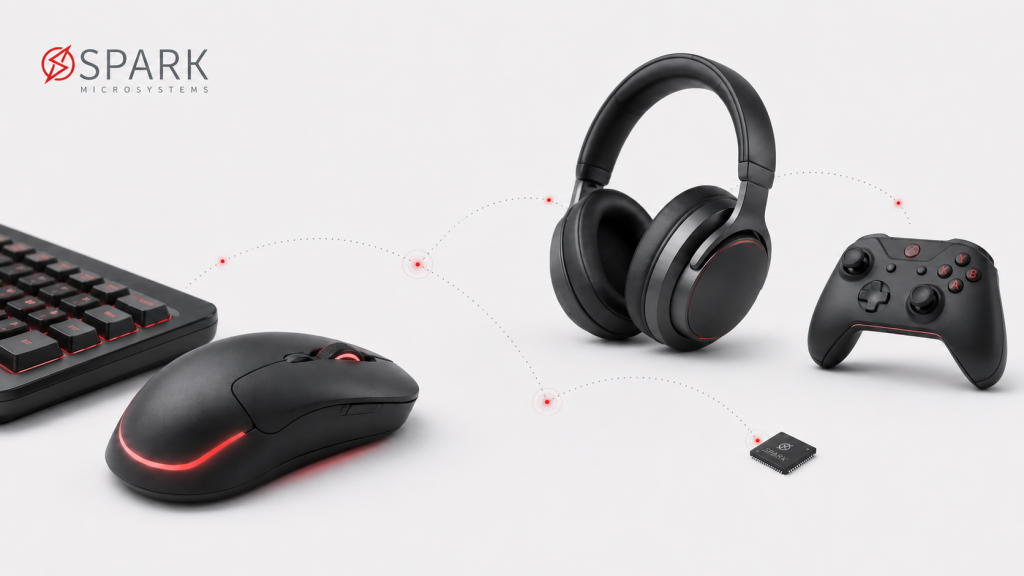

SPARK UWB technology is breaking the performance barriers for wireless gaming and esports hardware. From polling rate to latency to interference, the advantages SPARK UWB enables for gaming mice have been well chronicled, and the broader ecosystem of UWB-enabled gaming hardware is likewise set to expand.
Customer conversations at CES2024, the Game Developers Conference (GDC), Computex and other forums throughout the year likewise affirm that SPARK’s innovation in UWB wireless is raising the bar for high-performance competitive gaming. Tier-one gaming hardware manufacturers have taken notice, and you’ll be hearing more about SPARK’s gaming and partner initiatives in the months ahead.
SPARK is on a mission to put wireless gaming mice and peripherals on par with the performance profiles delivered with wired mice and peripherals. And surprisingly (or not), many competitive gamers still prefer wired mice despite the obvious freedom-of-movement constraints imposed by the cord.
These gamers would cut this cord if they could because all gamers instinctively want to liberate their movements for unencumbered, fast-paced gaming. The recent arrival of 8,000 Hz (8K) wireless mice has done much to close the gap, leveling the playing field between wireless and wired mice in the performance profile.
But what about the power profile?
UWB FOR LONGER GAMEPLAY
Wired mice will always have the advantage when it comes to power consumption. The host computer acts as power supply, so there’s never a need to recharge a wired mouse. But you’re left to tangle with the mouse’s tail during gameplay, and it’s a drag!
If you could get comparable gaming performance from a wireless mouse – and at 8K, you can – how long are you willing to live with your mouse’s cord?
There’s an important nuance to understand as you consider this question: 8K performance is incrementally more power hungry than 4K, 2K and 1K, so 8K gameplay will naturally necessitate more frequent mouse recharges.
What’s needed is an across-the-board power efficiency boost for wireless gaming mice, from 1K all the way to 8K. SPARK UWB delivers this capability.
Testing data shows that SPARK UWB connectivity can enable over 30% lower power consumption than 2.4 GHz wireless gaming mice operating at 8K. This translates to at least 30% longer uptime for your mouse and fewer interruptions for recharging, for longer more immersive gameplay. And this power benefit scales from 8K all the way to 1K, and battery life gets increasingly pronounced as it does.
SET YOUR MOUSE FREE
The gaming industry and gamers themselves are evolving from wired to wireless gaming hardware peripherals. No one wants to be tied down with wires and cords in this day and age, and 8K wireless gaming mice have arrived to make cords obsolete.
It’s the power profile that enables us to break the next barrier, and SPARK is at the forefront of this advancement in gaming mice and esports peripherals.
SPARK UWB has broken the barriers to achieving high polling rate wirelessly at extreme low latency.
SPARK UWB has broken the barriers to wireless gameplay with extremely low RF signal interference.
SPARK UWB has broken the barrier to greater power efficiency at 8K, which is where the performance envelope needs to reside for wireless mice to finally achieve parity with their wired predecessors.
SPARK is bringing game-changing innovation to gaming hardware OEMs by breaking the longstanding performance and power barriers between wired and wireless gaming mice.
Watch this space to see which barrier we break next.
For more information about SPARK’s UWB technology for gaming, check out our Gaming Applications page.