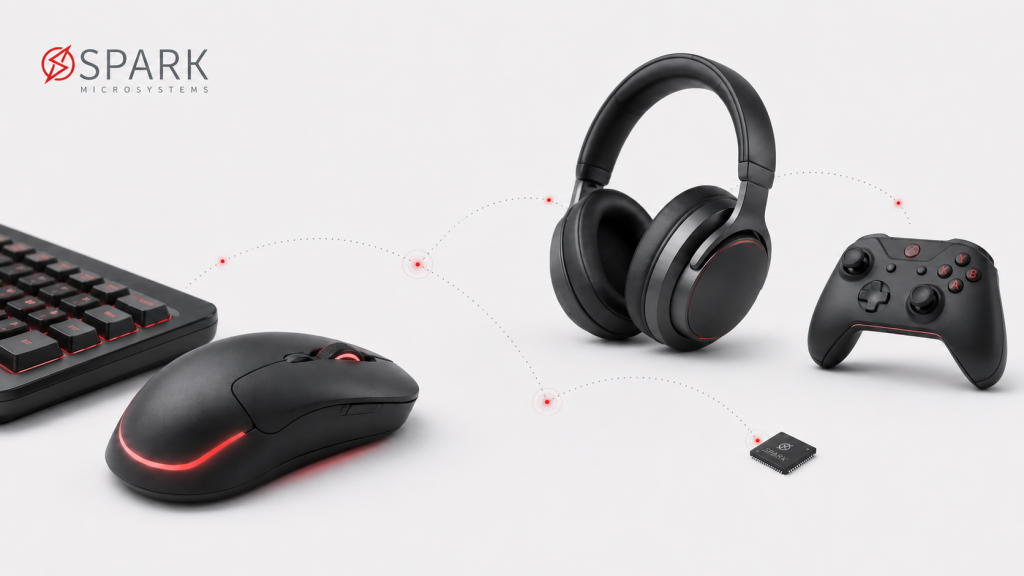
In previous 博客 posts we’ve highlighted some of the hot applications targeted with ultra-wideband (UWB) short-range wireless connectivity – wireless audio earphones, gaming headsets, AR/VR devices, smart glasses, positioning and tracking, to name a few.
What do all of these devices have in common? They’re all core enabling technologies for Extended Reality (XR), a superset of Augmented Reality (AR), Virtual Reality (VR) and Mixed Reality (MR).
These technologies point to a future where XR is ubiquitous in our lives, which explains why our top innovators are pushing so hard at cracking the code that finally unlocks XR for mass commercial consumption. Analysts have projected that XR could deliver a $1.5 trillion boost to the global economy by 2030, observing that “XR technology can benefit virtually all industries.”
XR is big business built atop breakthrough technology, intended to harness all of our senses to deliver ultra-immersive experiences like we’ve never experienced before. Fully realized, XR incorporates our sensory abilities for touch, sight and sound. All three senses must be accounted for, but for the purpose of this 博客, we’d like to deep dive on the topic of sound.
AUDIO INNOVATION
Audio quality and clarity is of course a paramount concern when it comes to XR, and UWB is orders of magnitude better performing than Bluetooth since there’s no need to compress the audio signal with UWB. For sound quality, UWB is vastly superior to Bluetooth because it enables 10X more data throughput.
But there’s another crucial advantage that UWB brings to the table when it comes to audio, and it’s massively important to the future of XR: spatial audio.
We’ve been hearing more and more about spatial audio in one form or another in recent years, and it means different things to different people depending on the application.
在电影和电视娱乐领域,空间音频主要表现为“环绕声”技术,它为声场带来动态深度和高度,从而营造更逼真的音频体验。近年来,这种方法被广泛应用于电影混音,尤其是在…… Dolby Atmos, which in turn has been licensed for use in Apple’s debut spatial audio offering.
In the world of gaming, spatial audio allows gamers to pinpoint enemies and other game elements from all sides and react to them faster. 空间音频可以极大地提升游戏体验。 performance by ensuring that crucial, positional audio cues are readily perceptible.
对于音乐爱好者来说, the benefits of spatial audio-equipped earphones 就像 2D 视频和 3D 视频的区别一样,它增添了一个全新的维度。你真的需要亲耳聆听才能完全理解这种转变。声音不再局限于离散的声道——例如立体声的左右声道——而是在一个 3D 音频空间中投射和移动。它模拟了声音混音中更丰富的深度和宽度,为音乐家和音响工程师提供了更多发挥创意的空间。
For AR/VR devices and smart glasses, spatial audio can be used to make virtual objects sound like they’re right next to us in the real world, with implications for a wide range of assistive applications. The specific 地点 of the sound provides hugely valuable guidance in the form of prompts and cues that guide us on our way and/or alert us to objects and activities around us.
EXTENDED REALITY DEPENDS ON SOUND
For all of these applications – aside from the entertainment value – audio is essential to establishing spatial positioning, relative orientation and other cues. It plays a major part in helping users establish 情境意识, and that’s precisely why it’s so important to XR applications going forward. We can’t freely move about in the virtual environments of the future in an informed way if we can’t sense depth in every direction. Spatial audio gives us this ability.
SPARK’s UWB technology enables the extreme data throughput that’s perfect to not only stream high quality, uncompressed audio but also stream inertial measurement unit (IMU) data at low latency to allow these spatial audio algorithms to work their magic. Because this rich sensor data can now be transmitted at such low latency with UWB, this could also shift the processing burden from the earphones to the source/dongle, opening the door to increased power savings for wireless earphones going forward. This approach could also accommodate more complex algorithms running on the source/dongle, enabling much longer usage between recharges and even better spatialization.
图片来源:Pixabay