Wireless That Competes With Wired

Competitive gaming has made one thing clear: wireless peripherals that cannot match wired performance are peripherals that serious players do not use. LE-UWB™ changes that equation.

WHY EXISTING WIRELESS FAILS

2.4 GHz has hit its ceiling for competitive gaming

These devices require high data throughput, sub-millisecond responsiveness, and battery life measured in days — all within compact, power-constrained form factors. Existing wireless technologies were not designed to meet all of these requirements simultaneously.

2.4 GHz is congested.

Wi-Fi, Bluetooth, gaming peripherals, and even USB 3.0 devices compete for the same spectrum. This interference makes it difficult to deliver the consistent, low-latency performance competitive gaming requires.

Bluetooth prioritizes efficiency, not speed.

Its connection model, bandwidth limits, and power management introduce latency and reduce polling performance, making it unsuitable for high-performance gaming mice and keyboards.
The result is a category of products that markets itself as "true wireless" while recommending wired mode for competitive play. LE-UWB™ eliminates that compromise.
WHAT LE-UWB™ ENABLES, BY APPLICATION

Wired performance. Wireless freedom.

SPARK LE-UWB™ gives Gaming system designers a wireless link built for the demands of on-device AI. Operating across the 6.2–9.5 GHz band with configurable 20.48 to 40.96 MHz symbol rates, LE-UWB™ enables direct control over the throughput, power, and latency tradeoff without changing silicon.
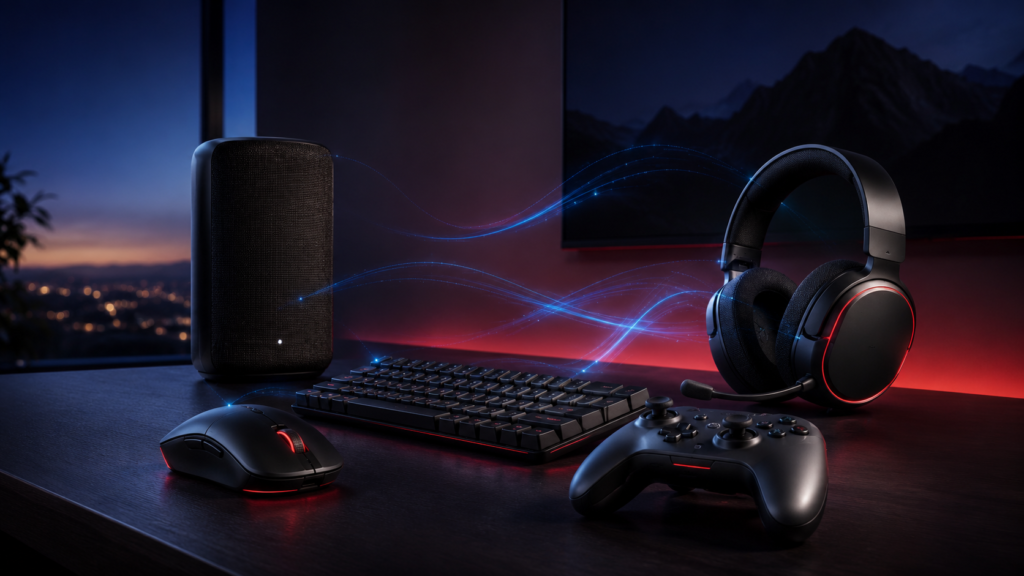
Gaming Mouse
True 8K wireless performance. Delivers wired-level polling rates with low latency, resists USB 3.0 and 2.4 GHz interference, and supports RGB and extra sensors without affecting performance.
Gaming Keyboard
Wired responsiveness, wireless freedom. Supports high polling rates, long battery life, RGB lighting, and additional peripherals — all without sacrificing speed or responsiveness.
Gaming Controller
Low latency for every input. Handles HD haptics, audio, and multiple input channels simultaneously while maintaining stable performance even in crowded Wi-Fi environments.
Gaming Headset & Audio
Lossless audio with near-zero delay. Streams uncompressed stereo audio and low-latency microphone input simultaneously, delivering wired-quality sound without cables.
Speakers
High-fidelity wireless audio. Provides uncompressed, synchronized audio with minimal latency, eliminating the trade-off between sound quality and responsiveness.

Start evaluating in days, not months

The SR1120 EVK provides everything needed to bring a working LE-UWB™ wireless link to life before committing to a custom layout. The kit combines the SR1120 transceiver with SPARK’s SDK, Datalink software interface, and application firmware examples, giving engineering teams a direct path from first power-on to a characterized wireless proof of concept.

Mouse Reference Design

Near-zero latency wireless mouse with wired-equivalent polling rates.

  • ≤150 µs end-to-end latency (8 kHz mode)
  • True 8 kHz sustained polling rate
  • RGB LED auxiliary channel
  • NXP LPC55S28 MCU + 26,000 cpi optical sensor

Silicon: SR1120 · USB-C dongle included

Keyboard Reference Design

Ultra-low latency wireless keyboard with full RGB and configurable polling

  • ≤150 µs latency
  • 8 kHz Polling rate
  • <17 mW active power
  • RGB LED auxiliary channel
  • NXP LPC55S28 MCU + USB-C dongle

Silicon: SR1120

3-in-1 System Demo

Unified wireless platform with mouse, keyboard, and headset on a single SR1120 network.

  • Mouse: 8k configurable polling
  • Keyboard: 8 kHz polling, stable concurrent operation
  • Headset: up to 96 kHz/24-bit stereo, 5 ms audio latency
  • Single USB-C dongle for all three devices

Silicon: SR1120

Products

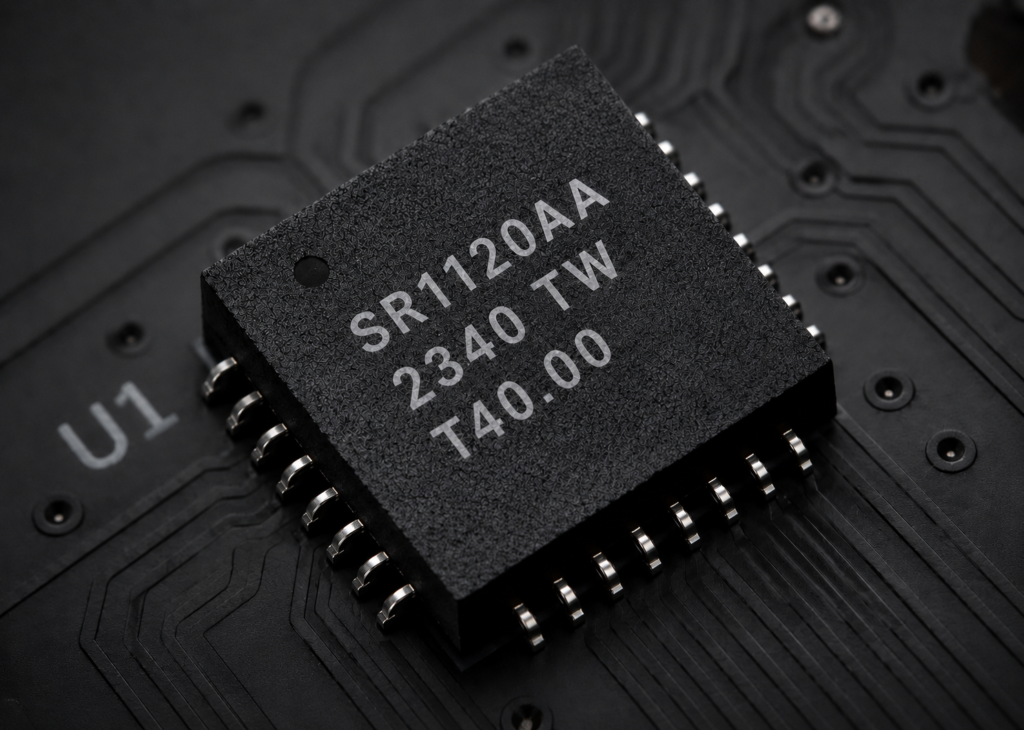
SR1120, LE-UWB™ transceiver.

Its configurable physical layer, dynamic PHY scaling, and antenna diversity support give system designers the flexibility to optimize their wireless link for the specific constraints of their device, without needing to change silicon as requirements evolve.
Documents

Demander la documentation

Documents

Download